
EUFRAS COFFEE Break: Fresh Insights into Carbon Farming
The EUFRAS COFFEE Break on “Fresh Insights into Carbon Farming – How It Works and What’s the Price” provides an overview of carbon farming, featuring insights from researcher Štěpán Krejčí on how carbon farming works in practice and its economic implications.
COFFEE BREAK
3/6/20262 min read
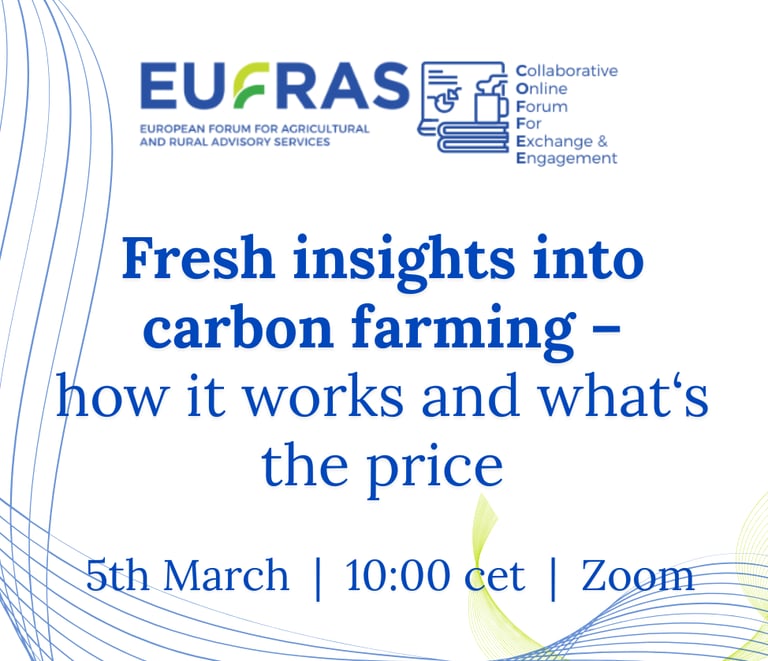
The EUFRAS COFFEE Break event, held at an unusual time on 5 March in cooperation with the Interreg project Carbon Farming CE, attracted strong interest from the community. The session, titled “Fresh Insights into Carbon Farming – How It Works and What’s the Price,” gathered more than 100 registered participants, with around 50 joining live during the event.
The discussion focused on the concept of carbon farming, its economic aspects, and its practical implementation. The guest speaker, Czech researcher Štěpán Krejčí from Agricultural Research Ltd. Troubsko, highlighted carbon farming as a strategic approach to mitigating climate change while improving soil fertility. Although the transition requires initial investments and patience, in the long term it can strengthen farm sustainability and economic viability.
During the presentation, Štěpán Krejčí explained how practices such as reduced soil tillage, cover cropping, and the use of organic fertilizers help capture atmospheric carbon and store it in the soil, improving soil health and productivity. The session also explored both the environmental benefits and the practical challenges farmers face, including high upfront investment in machinery and possible yield reductions during the transition period.
In addition, the presentation addressed the complex and sometimes controversial nature of carbon credit markets and shared research findings on the economic viability of using compost and digestate. The speaker emphasized that successful implementation of carbon farming practices in Europe will require long-term data and locally adapted solutions.
Key Insights
Improving Soil Health – Carbon sequestration enhances soil structure, water retention, and ecosystem resilience.
Practical Carbon Farming Techniques – Organic fertilization, cover crops, agroforestry, reduced tillage, and mulching help capture and retain carbon.
Economic Transition Period – The first years may involve high costs and potential yield reductions before long-term benefits appear.
Local Resource Efficiency – Using locally available resources such as compost or digestate improves economic feasibility.
Cautious Approach to Carbon Credits – Farmers are encouraged to focus on the long-term benefits for soil and farm sustainability rather than relying on carbon credit income.
A sincere thank you to Štěpán Krejčí for sharing his valuable knowledge, to Anita Dzelme for moderating the event, and to all participants for their engagement and insightful questions.
If you were unable to join the session live, you can now watch the recording and explore the presentation materials at your convenience.
We look forward to seeing you at the next EUFRAS Coffee Break events!

Riga str 34, Ozolnieki, Jelgavas novads, LV-3018, Latvija
Phone: +371 29736468
mail: anita.dzelme@llkc.lv
Requisites:
Biedrība "Eiropas Lauksaimniecības un lauku konsultantu asociācija"
NGO " European Forum for Agricultural and Rural Advisory Services"
Reg nr. 40008219277